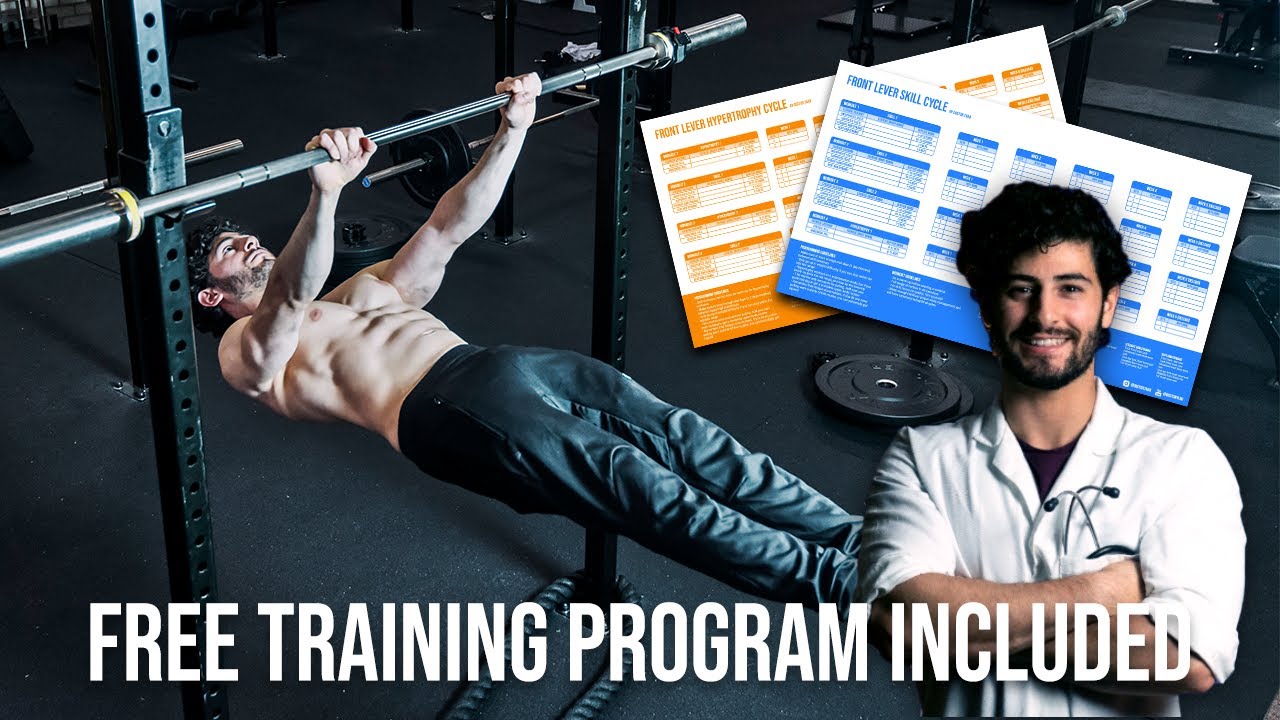

The front lever is, in my opinion, the single most impressive static hold in calisthenics. A perfectly horizontal body suspended from a bar with straight arms -- it demands a rare combination of lat strength, core rigidity, scapular control, and mental toughness. I've spent years mastering this skill and even more years coaching others through it, and I can tell you with confidence: most tutorials out there overcomplicate it, underprepare you, or skip critical steps entirely. This is my attempt to fix that. Welcome to the most comprehensive front lever tutorial I've ever put together, complete with a training program you can start today.
What Is the Front Lever and Why Is It So Hard?
The front lever is an isometric hold where you hang from a bar with straight arms and hold your body perfectly horizontal -- parallel to the ground -- face up. It primarily taxes the latissimus dorsi, teres major, posterior deltoid, rhomboids, lower traps, and the entire anterior core chain. What makes it brutally difficult is the lever arm: your body is essentially a long beam, and the farther your center of mass is from the bar, the more torque your lats and core must produce to maintain position. For reference, a 75kg athlete performing a full front lever is generating roughly the same lat force as a heavy weighted pull-up -- except isometrically, at a severe mechanical disadvantage, for time. It's no joke.
Prerequisites Before You Start
Before you even think about front lever progressions, you need a baseline of pulling strength and body control. Here's what I recommend as minimum prerequisites:
- •At least 10-12 strict pull-ups with full range of motion
- •A 15-20 second dead hang with active shoulders (scapulae depressed and retracted)
- •Basic understanding of posterior pelvic tilt and hollow body position
- •No active shoulder or elbow injuries
If you can't hit these benchmarks, spend four to eight weeks building your pull-up numbers and shoulder stability first. There's no shame in that -- it's the smart play for long-term progress.
Understanding Proper Front Lever Form
Let me break down what a correct front lever looks like, because form errors are the number one reason people plateau. Your body should form a straight line from shoulders to toes. Hips must not sag -- this is the most common error, and it turns the front lever into a glorified inverted hang. Your scapulae should be depressed (pulled down away from your ears) and retracted (squeezed together). Think about driving your elbows straight down toward your hips, not pulling with your hands. Your core should be in a slight posterior pelvic tilt -- squeeze your glutes and brace your abs as if someone is about to punch you in the stomach. Arms are fully straight. Any bend in the elbows significantly reduces the difficulty, which is why bent-arm variations are NOT front lever progressions -- they're a different exercise entirely.
The Progressions: From Zero to Full Front Lever
Here's where the real work begins. I've organized these progressions from easiest to hardest, and I want you to master each one before moving to the next.
Progression 1: Tuck Front Lever
Hang from the bar, pull your knees to your chest, and rotate your body until your back is parallel to the ground. Knees are tucked tightly. Focus on scapular depression and keeping your hips level with your shoulders. This is where you learn the fundamental motor pattern -- don't rush past it. Target: 3 sets of 15-20 second holds.
Progression 2: Advanced Tuck Front Lever
Same position, but now extend your knees slightly so your thighs are no longer against your torso. Your shins should be roughly vertical -- knees bent at about 90 degrees, but thighs closer to parallel with the ground. This increases the lever arm significantly. You'll feel your lats working much harder. Target: 3 sets of 12-15 second holds.
Progression 3: Single Leg (Half-Lay) Front Lever
One leg extends fully while the other remains tucked. This is a substantial jump in difficulty because extending one leg moves your center of mass much further from the bar. Alternate legs between sets. Keep the extended leg tight and active -- point your toe and squeeze your quad. Target: 3 sets of 8-12 second holds per leg.
Progression 4: Straddle Front Lever
Both legs are now extended but spread wide in a straddle. The wider the straddle, the easier (shorter lever arm). Over time, bring your legs closer together. Your hip adductors and core will be working overtime here. Target: 3 sets of 8-12 second holds.
Progression 5: Full Front Lever
Legs together, body straight, completely horizontal. This is the summit. Every muscle from your lats to your toes is engaged. When you first achieve this, holds of three to five seconds are completely normal and a legitimate milestone. Target: 3 sets of 5-8 second holds, working up to 10+ seconds over time.
Essential Supplementary Exercises
Progressions alone aren't enough. You need to build the specific strength qualities that the front lever demands. Here are my top supplementary exercises:
- •Front lever raises (from inverted hang to horizontal): These build dynamic strength through the full range. Use whatever progression level you're working at. 3 sets of 3-5 reps.
- •Front lever pulls (horizontal body pull-ups): From your current progression, pull your body up toward the bar while maintaining horizontal position. Incredibly demanding. 3 sets of 3-5 reps.
- •Ice cream makers: Start in an inverted hang, lower to horizontal, pull back up. This is essentially a front lever raise plus a front lever row in one fluid motion. 3 sets of 3-5 reps.
- •Straight-arm lat pulldowns (on cable or band): This isolates the lat engagement pattern of the front lever without the full body demands. 3 sets of 10-15 reps.
- •Dragon flags: Lie on a bench, grip behind your head, and lower your straight body from vertical to horizontal. Phenomenal core and lat carryover to front lever. 3 sets of 5-8 reps.
The 12-Week Front Lever Program
Here's a program structure I've used with myself and the athletes I coach. Train front lever two to three times per week with at least one rest day between sessions.
- •Weeks 1-4 (Foundation): Current progression holds (4 sets of max hold), front lever raises at one level below (3 x 5), straight-arm pulldowns (3 x 12), dragon flags (3 x 8). Total session time: 25-30 minutes.
- •Weeks 5-8 (Building): Attempt next progression for 1-2 sets (even if only 3-5 seconds), current progression holds (3 sets of max hold), ice cream makers at current level (3 x 3-5), front lever pulls at one level below (3 x 5). Total session time: 30-35 minutes.
- •Weeks 9-12 (Peaking): Next progression holds (4 sets of max hold), front lever raises at current level (3 x 3-5), supplementary work of your choice (2-3 sets). Deload in week 12: halve your volume but maintain intensity.
Common Mistakes and How to Fix Them
- •Hips dropping: Squeeze your glutes harder and think about driving your hips up. Film yourself from the side.
- •Shoulders elevating: Actively depress your scapulae before every hold. Think "long neck" -- pull your shoulders away from your ears.
- •Holding your breath: Breathe. Seriously. Short, controlled breaths through pursed lips. Holding your breath spikes blood pressure and limits hold time.
- •Skipping progressions: If you can't hold a progression for at least 10 seconds with good form, you're not ready for the next one. Period.
- •Training front lever every day: Your connective tissues and nervous system need recovery. Two to three sessions per week is optimal for most people.
Key Takeaways
- •Build a pulling strength foundation (10-12 strict pull-ups minimum) before starting front lever work
- •Master each progression (tuck, advanced tuck, single leg, straddle, full) before advancing
- •Proper form means depressed scapulae, posterior pelvic tilt, straight arms, and hips level with shoulders
- •Supplement with front lever raises, pulls, ice cream makers, and dragon flags
- •Train front lever 2-3 times per week with structured periodization over 12+ weeks
- •Film yourself regularly -- what feels horizontal often isn't
Final Thoughts
The front lever took me years to develop, and it remains one of the skills I'm most proud of. There's no shortcut -- it's progressive overload, patience, and relentless attention to form. Follow this program, respect the progressions, and film your holds regularly to check your form. The day you hold a clean, full front lever for the first time will make every frustrating training session worth it. I promise you that.