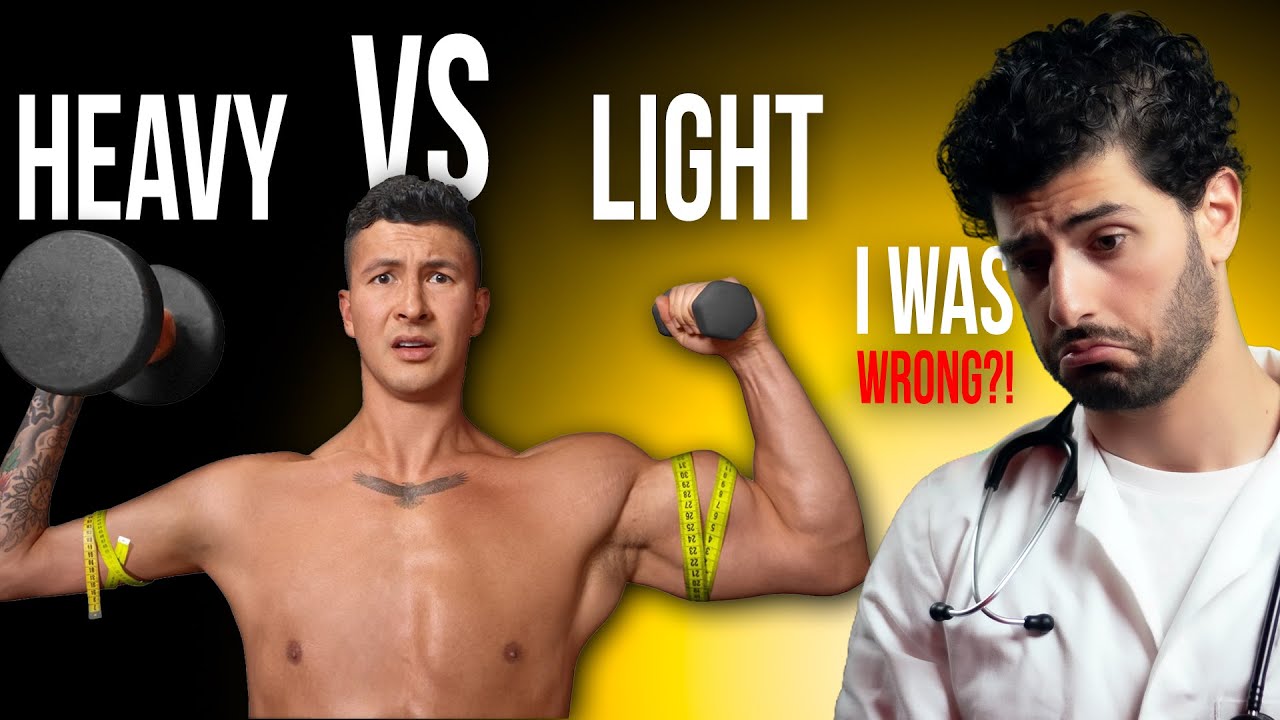

The debate between heavy weights and light weights for muscle growth has raged in gyms and online forums for decades. One camp insists you need to lift heavy or go home. The other swears by high reps and the sacred burn. But what if you could test both approaches simultaneously, on the same person, during the same training period? That is exactly what fitness creator Jeremy Ethier did in a meticulously designed 60-day self-experiment, and I sat down to analyze every claim, every data point, and every conclusion.
The Study Design: Surprisingly Rigorous
The experiment is straightforward in concept but impressive in execution. For 60 days, Jeremy trained one side of his body with heavy weights (reaching failure within 3 to 6 reps) and the other side with light weights (reaching failure within 15 to 30 reps). A coin toss determined which side went heavy, a randomization method that I note is actually used in legitimate randomized controlled trials. Both sides received the same number of total sets, and every set was taken close to failure. To support muscle growth, Jeremy ate in a small caloric surplus.
What impressed me most was the measurement protocol. Jeremy used a full-body MRI scan at baseline and at the end of the 60 days, supplemented by ultrasound and circumference measurements. MRI provides individual muscle resolution that ultrasound cannot match, and it is rarely used in studies because of the cost. The thoroughness of this approach elevated the experiment well above typical YouTube fitness content.
To add another dimension, Jeremy recruited Dennis, a complete beginner, to perform the same protocol. This created an informal comparison between trained and untrained responses to the same intervention, something that research literature often lacks.
The Heavy Side: Strength Gains and Joint Stress
As expected, the heavy side showed significantly greater strength gains for both Jeremy and Dennis. Jeremy's Bulgarian split squat progressed from 205 to 215 pounds on the heavy side while the light side stayed at the same weight. Dennis, as a beginner, showed even more dramatic strength gains on his heavy side due to what I identify as neural adaptation, the nervous system becoming more efficient at recruiting motor units for a specific task.
However, the heavy side came with a cost. Jeremy experienced sharp knee pain during one exercise, highlighting one of the major trade-offs of exclusively heavy training. I explain that heavy loads strengthen tendons over time, making them more resilient. But if every session involves near-maximal loading, the cumulative joint stress can exceed the rate of tendon adaptation, especially on exercises that place the joints in mechanically disadvantaged positions.
This is one of the strongest arguments that bodybuilders make for periodizing between heavy and light phases. High volume at high intensity creates an unsustainable load on the joints. Deload weeks become essential, and the risk of overuse injuries climbs.
The Light Side: Endurance Adaptation and Mental Battles
The light side told a different story. Strength gains were minimal, but something interesting happened: the muscles adapted to high-repetition work. The burn that was unbearable in the first weeks became manageable by week four. Jeremy attributes this to endurance adaptation, including increased mitochondrial density and improved pain tolerance.
I raise a fascinating neuroscience question about this adaptation. If the brain is learning to tolerate the burn better, why does it only apply to one side? The brain is a central organ. One would expect increased pain tolerance to be bilateral. Yet the data clearly showed that the light side adapted to the burn while the heavy side did not show the same endurance gains. I will admit the science does not have a clear answer to this question, and I think it is an area ripe for further study.
The mental toll of light training also proved significant. High-rep sets to failure are psychologically grueling. Jeremy reported that the extra fatigue from the light side was burning him out mentally. This is a practical consideration that pure hypertrophy research often ignores: adherence matters, and if a training method makes you dread every session, its theoretical effectiveness is irrelevant.
I identify what I consider the biggest limitation of the entire experiment: systemic fatigue. Because both sides are trained in the same session by the same person, fatigue from one side inevitably affects the other. The high-rep light side generates significant metabolic fatigue that could impair recovery and performance on the heavy side, and vice versa.
This is not a minor concern. Central nervous system fatigue does not respect the distinction between left and right. A grueling set of 30-rep lunges on the left leg will affect neural drive to the right leg. This means the experiment cannot definitively attribute results to one modality or the other, because each side is being influenced by the training of the opposite side.
The Results: Closer Than You Think
After 60 days, the muscle growth results were remarkably similar between sides. For Jeremy, the absolute differences were as small as 15 grams per muscle, nowhere near statistical significance. Ultrasound and circumference measurements confirmed the MRI findings. Both heavy and light training produced essentially identical hypertrophy when volume and effort were equated.
Dennis the beginner told a slightly different story. Every muscle trended toward slightly more growth on the light side, though the differences were still small. I suggest that if Dennis had been better at pushing to true failure, which is a skill that beginners lack, the difference might have been more pronounced.
The most striking finding was the body composition change in Dennis. He gained 3 pounds total, virtually all of which was muscle, while his body fat percentage actually dropped from 18.4 to 17.8 percent. This is true body recomposition, a phenomenon that is most achievable in beginners, and I want to highlight recent research by Eric Helms showing that a 10 to 15 percent caloric surplus can support muscle growth without excessive fat gain even in trained lifters.
What This Means for Your Training
My conclusion aligns with Jeremy's: the weight on the bar matters far less than the effort behind it. For muscle hypertrophy, both heavy and light training produce similar results when sets are taken close to failure and volume is equated. The practical implications are significant.
If joint health is a concern, lighter weights with higher reps provide a viable path to muscle growth with less mechanical stress on tendons and ligaments. If strength is the primary goal, heavier weights are non-negotiable because they produce greater neural adaptations. And for most people, a combination of both across a training cycle, what I call periodization, provides the best of both worlds.
Jeremy arrives at a recommendation of 6 to 15 reps as the practical sweet spot: light enough to spare the joints but heavy enough that each set does not feel like a mental battle. I agree with this range as a default while advocating for occasional forays into both lower and higher rep ranges to provide varied stimuli.
Key Takeaways
- •Heavy and light training produce nearly identical muscle growth when sets are taken to failure and volume is equated
- •Heavy training produces significantly greater strength gains due to neural adaptation
- •Light training is easier on the joints but more mentally demanding and produces greater endurance adaptation
- •Systemic fatigue from training one side affects the other; within-subject unilateral designs have inherent limitations
- •Beginners can achieve true body recomposition, gaining muscle while losing fat, with appropriate training and a small caloric surplus
- •The 6 to 15 rep range offers the best practical balance for most athletes
- •Periodizing between heavy and light phases across a training cycle provides the most complete training stimulus
- •Effort and proximity to failure matter more than the specific load used
The heavy versus light debate, it turns out, is largely a false dichotomy. Both work. The real variable that determines results is effort. How close to failure can you push, how consistently can you show up, and how intelligently can you manage fatigue across weeks and months? That is what separates those who grow from those who stall.