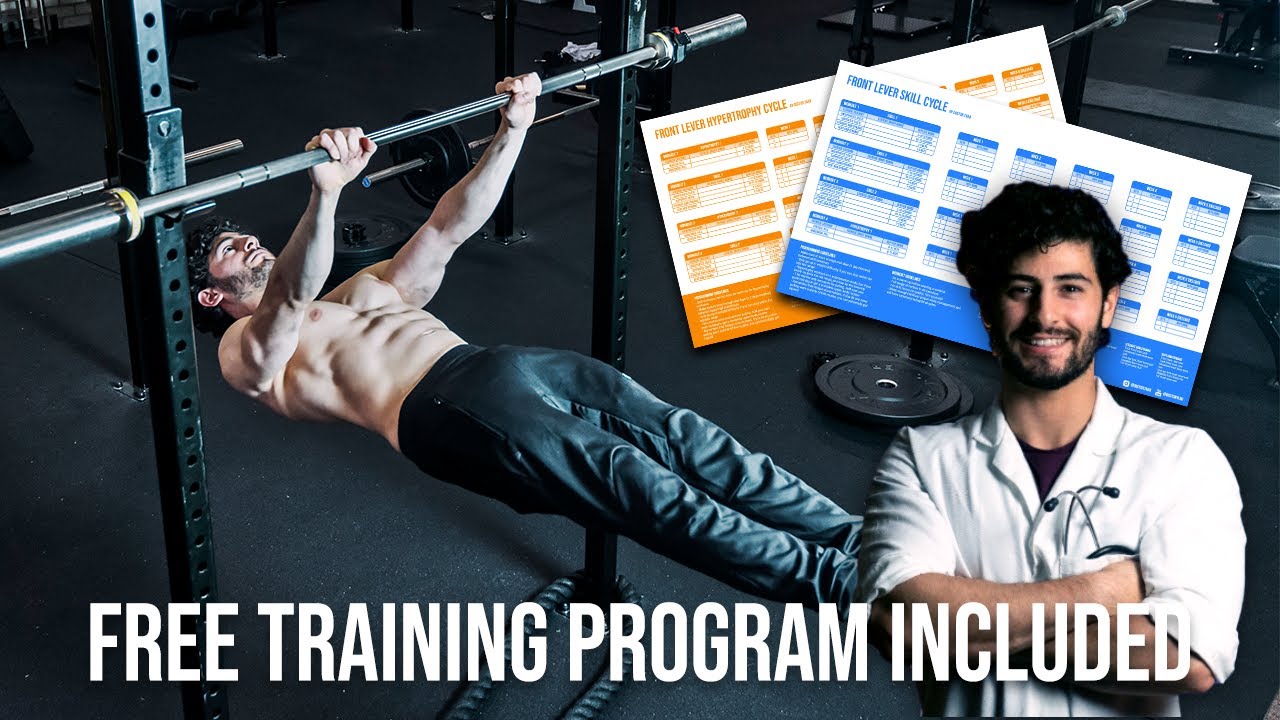
What happens when you take a calisthenics athlete who tore his bicep, send him on a multi-year journey across Europe to train with the strongest bodyweight athletes alive, and then sit him down to spill everything he learned? You get one of the most illuminating conversations in recent calisthenics media. On my podcast, Nicky Lyan, a polyglot athlete who has trained with legends from France, Spain, Italy, and beyond, joined me to unpack the universal principles hidden beneath wildly different training approaches. The result is a masterclass in how elite athletes actually train, and why so much of what we assume about calisthenics programming may be wrong.
The Bicep Tear Brotherhood
Both Nicky and I share a bond that only a specific group of calisthenics athletes understand: the bicep tear. It is an injury that forces a binary decision. Quit the sport, or come back smarter. Both of us chose the latter, as did our mutual friend Onizuka, widely considered one of the strongest calisthenics athletes in the world.
Nicky describes the tear as something that feels simultaneously acute and chronic. In the moment, it comes out of nowhere. But with the benefit of hindsight and improved technical understanding, the warning signs become visible: overuse symptoms creeping in, technical errors compounding over time, and a sport culture that lacks formal institutions or structured learning pathways. Most calisthenics athletes, Nicky explains, get into the sport because they saw someone do something incredible on a video or in a park. They start trying without understanding conditioning, accessory work, or the relationship between stress and adaptation. Injuries are almost inevitable under those conditions.
The silver lining, we both agree, is that a catastrophic injury forces you to confront every technical and programming error that led to it. If you choose to come back, you come back fundamentally different.
The Warm-Up Revelation
The first paradigm-shattering lesson from Nicky's travels involved something deceptively simple: warm-ups. When he first trained with Ilas, one of France's elite calisthenics athletes, Nicky watched in disbelief as Ilas walked up to the bar and simply started training. No band work. No gradual progressions. Just straight into high-level skills.
At first, this seemed reckless. But as Nicky trained with more athletes across Europe, a pattern emerged. The athletes who trained with very high frequency, sometimes twice daily like Ilas, needed minimal warm-up because their nervous system was already in a perpetual state of readiness. Meanwhile, athletes like Gusta, who trained with extreme intensity only once per week, would warm up for an hour before touching a working set.
I connected this observation to research by Professor Keith Baar on tendon adaptation, noting that studies show tendons respond optimally to mechanical loading performed twice daily with approximately six hours between sessions. The fact that Ilas intuitively arrived at a training structure that aligns with cutting-edge tendon science, without knowing the science itself, fascinated both of us.
The takeaway is not that warm-ups are unnecessary. It is that warm-up requirements exist on a spectrum determined by training frequency, volume, and intensity. An athlete training twice daily at moderate intensity needs far less warm-up than an athlete destroying themselves twice a week.
High Frequency vs. Low Frequency: The Great Debate
When I pressed Nicky for a definitive stance on training frequency, the answer was nuanced but clear: Nicky personally favors high frequency. His reasoning is both practical and physiological.
First, he simply loves to train every day. Resting five days a week would be psychologically unbearable. Second, low-frequency training forces athletes to cram enormous volume into fewer sessions, which pushes them dangerously close to their maximum intensity threshold, what Nicky calls "redlining the RPM." This increases injury risk and leaves the athlete wrecked for days afterward.
High-frequency training, by contrast, allows each session to operate at roughly 60 to 70 percent capacity. The athlete trains hard but leaves energy in reserve, enabling consistent daily training. Over the course of a week, this approach actually accumulates more total volume than the low-frequency alternative. Nicky illustrates with a simple example: if his maximum capacity is 10 sets, doing 10 in one session means he cannot train the next day. But doing 6 sets daily for seven days yields 42 total sets versus 20 from two maximal sessions.
I add the scientific framework here: the Stimulus Recovery Adaptation (SRA) curve. This well-documented principle states that after a training stimulus, performance temporarily decreases during recovery, then supercompensates above baseline during adaptation. The optimal time for the next session is at the peak of that supercompensation. For high-frequency training, this curve must be shorter, which means intensity per session must be lower. The challenge, as I see it, is that the SRA curve for tendons may differ significantly from the SRA curve for muscles, and the science is still catching up.
The Universal Principles Beneath the Surface
Perhaps the most valuable insight from the conversation is Nicky's observation that despite wildly different training approaches, every successful elite athlete he encountered was operating on the same fundamental principles. The details differed enormously: some trained twice daily, others once weekly; some warmed up extensively, others not at all; some used structured programs, others trained intuitively. But beneath all of this variation, the same principles governed their success.
These principles include respecting the relationship between stress and adaptation, managing total weekly volume relative to recovery capacity, training at appropriate intensities for specific goals, and being honest about one's current level. Nicky frames it beautifully: every person's life story is completely unique, but the principles that govern human experience, birth, emotion, growth, are universal. Calisthenics training works the same way.
Skills vs. Strength: Different Training Demands
Nicky and I agree that skill training and strength training require fundamentally different approaches. I have long preached a philosophy of building foundational strength through weighted calisthenics before pursuing advanced skills. The reasoning is that a strong athlete has more margin for error, can train skills at a lower relative intensity, and therefore can sustain higher training frequencies without risking injury.
Nicky's observations from the field confirm this. The athletes who progress fastest in skills are those who have built a substantial strength base. But I am also honest about the limitations of this approach: weighted pull-ups and dips do not directly predict front lever or planche performance. There are too many variables, including body proportions, tendon resilience, and specific straight-arm strength, that mediate the transfer.
The practical recommendation is to build general pulling and pressing strength as a foundation, then transition to specific skill work with the understanding that the timeline for skill acquisition is highly individual and difficult to predict.
The Role of Ego in Injury Prevention
Nicky offers a powerful insight about the single biggest obstacle to safe, sustainable calisthenics progress: the human ego. He argues that the body can adapt to virtually any stress if given sufficient time. The problem is that excitement, impatience, and the desire to achieve skills quickly cause athletes to apply stress faster than adaptation can occur. The same passion that draws people to calisthenics is the thing that causes most injuries.
I reinforce this with my medical perspective, noting that calisthenics lacks the formal coaching infrastructure of established sports like gymnastics. Athletes are often self-taught, learning from social media rather than qualified coaches. This makes ego-driven overreach even more common because there is no external check on training decisions.
Key Takeaways
- •Warm-up requirements depend on training frequency and intensity; high-frequency athletes may need minimal warm-up while low-frequency athletes need extensive preparation
- •High-frequency, moderate-intensity training can accumulate more weekly volume than low-frequency, high-intensity training while reducing injury risk
- •The Stimulus Recovery Adaptation curve governs optimal training timing, but its duration varies by tissue type and individual
- •Tendon adaptation research supports twice-daily loading with six-hour gaps between sessions
- •Every successful elite athlete operates on the same fundamental principles despite vastly different surface-level approaches
- •Build foundational strength before pursuing advanced skills, but recognize that transfer from weighted exercises to static skills is not perfectly predictable
- •The human ego is the primary driver of overuse injuries in calisthenics; patience with adaptation is the most important virtue
My conversation with Nicky Lyan is a rare window into the real training culture of elite calisthenics. It strips away the social media polish to reveal a sport still figuring itself out, guided by athletes who are willing to learn from each other across borders and language barriers. For anyone serious about calisthenics progression, the universal principles we discussed are far more valuable than any specific program.